 TV & Movie Log Book
Book and movie journal: log both, compare adaptations
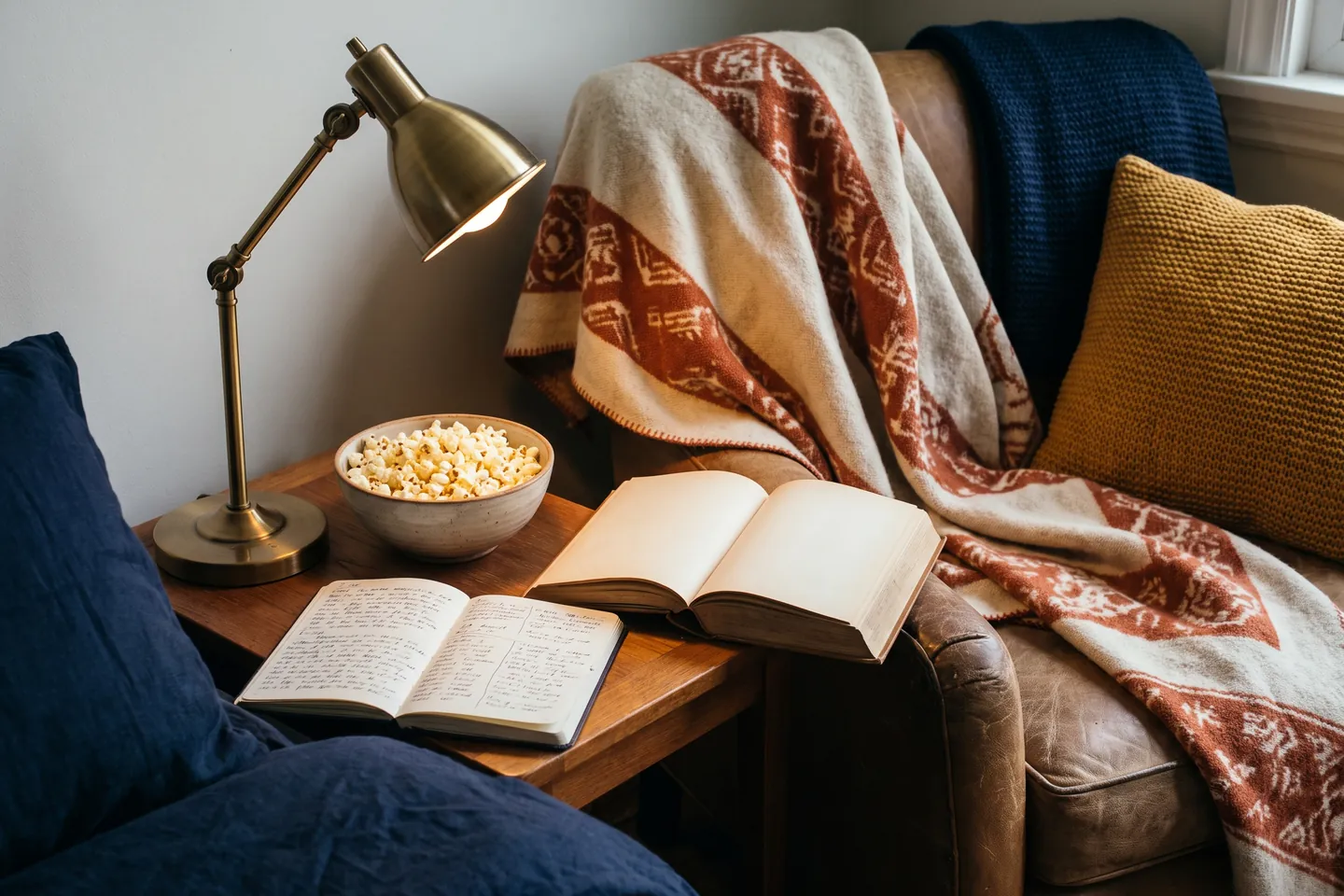
A book and movie journal is one notebook or binder where you record everything you read and everything you watch, so a single year of stories sits in one place. The simplest setup that lasts has three parts: a one-line book log (date finished, title, author, rating), a one-line film log (date watched, title, year, rating), and an adaptation page for every story you meet in both forms, where you note which you took in first, what changed between the book and the film, and which version you would hand to a friend. The adaptation page is the reason to keep books and films together at all: two separate logs cannot show you that comparison. Below are the fields, a ready-to-copy adaptation entry, five book and film pairs to start with, and how to set it up on paper.
What goes in a book and movie journal
Keep the book side and the film side parallel, with the same few fields in the same order, so a glance at either page tells you the same things. Add only what you will fill every time.
| Section | Book side | Film side | Why keep it |
|---|---|---|---|
| Log line | Date finished, title, author, rating | Date watched, title, year, rating | A complete record that takes under a minute per entry |
| Format | Print, ebook, audiobook | Cinema, streaming, disc | You remember the experience, not only the story |
| One line | A sentence or idea to keep | A scene to keep | Brings the whole thing back months later |
| Adaptation link | "Film: page 12" | "Book: page 4" | Lets you jump to the comparison |
| Year end | Top five books | Top five films | The reward for logging all year |
A practical rule: if you leave a field empty three entries in a row, cross it off the template. A journal with fewer fields that you fill every time beats a detailed one that stops in February.
The adaptation page: what a separate log cannot do
When a book is turned into a film, the result is a film adaptation. The Wikipedia article on film adaptation (read October 5, 2026) defines it as a film that "transfers the details or story of an existing source text, such as a novel, into a feature film", and notes that a novel is the most common source. The script written from it is an adapted screenplay, which the Academy Awards honor in a category of its own; the Academy's page for the 96th ceremony (read October 5, 2026) lists American Fiction as the 2024 winner for Writing (Adapted Screenplay).
That is exactly the kind of story a book and movie journal is built for. Give each pair one half page, laid out like this:
``` Story: ______ Book: __ (author, year) Read: _/_ Film: __ (year) Watched: _/_ Which came first for me: book / film
Kept from the book: _____ Changed or cut: _____ Added by the film: ______ Best moment in the book: ____ Best moment in the film: ________
Verdict: book / film / tie Hand to a friend: ______ ```
Fill the first four lines the day you finish the second version, while both are fresh. The "changed or cut" line is where the page earns its place: one character merged into another, an ending softened, an inner monologue turned into a look. Those notes are also what make a book club or a movie night conversation easy.
Five book and film pairs to start with
If you want a first few adaptation pages, these pairs span very different eras and genres. Each title and year was checked against the film's Wikipedia entry (links under sources, read October 5, 2026).
| Book (author, year) | Film (year) | Good question for your "changed or cut" line |
|---|---|---|
| Little Women (Louisa May Alcott, 1868) | Little Women (2019) | How does the film reorder the timeline? |
| To Kill a Mockingbird (Harper Lee, 1960) | To Kill a Mockingbird (1962) | What happens to the narrator's adult voice? |
| Jaws (Peter Benchley, 1974) | Jaws (1975) | Which subplots stay in the book? |
| The Remains of the Day (Kazuo Ishiguro, 1989) | The Remains of the Day (1993) | How does a film show a narrator who hides his feelings? |
| Erasure (Percival Everett, 2001) | American Fiction (2023) | What does a new title change about the story? |
The fifth pair is a reminder to log the source title, not only the film's: an adaptation can carry a different name from the book it comes from, and your journal is the place that keeps both.
How to set up a book and movie journal on paper
- Pick one home. A notebook, a planner section or a binder you already open. Splitting books and films across two places is how one side goes quiet.
- Give each side its own log pages. Books from the front, films from a divider in the middle, or alternating pages if you prefer one stream. One line per entry.
- Number the pages. Adaptation pages only work if you can write "see page 12" in the log line.
- Keep adaptation pages together at the back, so they read as their own collection by the end of the year.
- Close the year with two top-five lists and one line on the best adaptation you met.
- Keep your place in the book. A tracker bookmark holds the page you reached and the lines you want to copy, so the log entry is quick when you finish.
If you keep a bullet journal, the same structure works as two collections plus a cross-referenced spread. For more on making the film side stick, see how to make a movie journal.
Read first or watch first?
There is no right order, and your journal does not need one. It only needs you to record which came first, because that choice colors everything else on the page: read first and you may notice what was cut, watch first and you may picture the cast while you read. Writing down the order lets you see your own pattern over a year. A simple habit: when you finish a book that has a film, add the film to your watchlist the same day and leave the adaptation page half filled until you see it.
If you want both halves printed
Our Movie Journal covers the watching side of a book and movie journal. It is a $6.99 printable year of film with 73 pages: 12 monthly logs with 31 lines each and a wrap-up page per month, 30 review pages, 2 watchlists, a year at a glance, trackers for genres, decades, directors, cinema visits, rewatches, firsts and movie nights, a goals page with a 100-film tracker, a quotes page, a top 25, your own awards and a year in film page. It comes in US Letter, A4 and A5. It has no book pages and no adaptation page, so draw those yourself. For the reading side, our sister shop Print Bookmarks makes printables for books: The Year in Books, a yearly reading tracker with twelve months of five books each ($4), and Reading Now tracker bookmarks for the book you are in the middle of. Put both in the same binder and keep the adaptation pages in between. The Movie Journal PDFs are delivered on the order page after payment. Nothing is shipped: you print them at home or at a copy shop at 100% (actual size), and since no year is printed, you can start any time.
See the printable Movie Journal ($6.99, US Letter, A4 and A5)
Frequently asked questions
What is it called when you take a book and turn it into a movie?
It is called a film adaptation, or simply an adaptation: a feature film that transfers the story of an existing text, most often a novel, to the screen. The screenplay written for it is called an adapted screenplay, and the Academy Awards give that its own category.
Sources
- Film adaptation (Wikipedia) (last checked 2026-10-05)
- Academy Award for Best Adapted Screenplay (Wikipedia) (last checked 2026-10-05)
- The 96th Academy Awards, 2024 (Oscars.org) (last checked 2026-10-05)
- American Fiction (film), title and year check (Wikipedia) (last checked 2026-10-05)
- Little Women (2019 film), title and year check (Wikipedia) (last checked 2026-10-05)
- Jaws (film), title and year check (Wikipedia) (last checked 2026-10-05)
- The Remains of the Day (film), title and year check (Wikipedia) (last checked 2026-10-05)
- To Kill a Mockingbird (film), title and year check (Wikipedia) (last checked 2026-10-05)