 TV & Movie Log Book
Bullet journal movie tracker that lasts the whole year
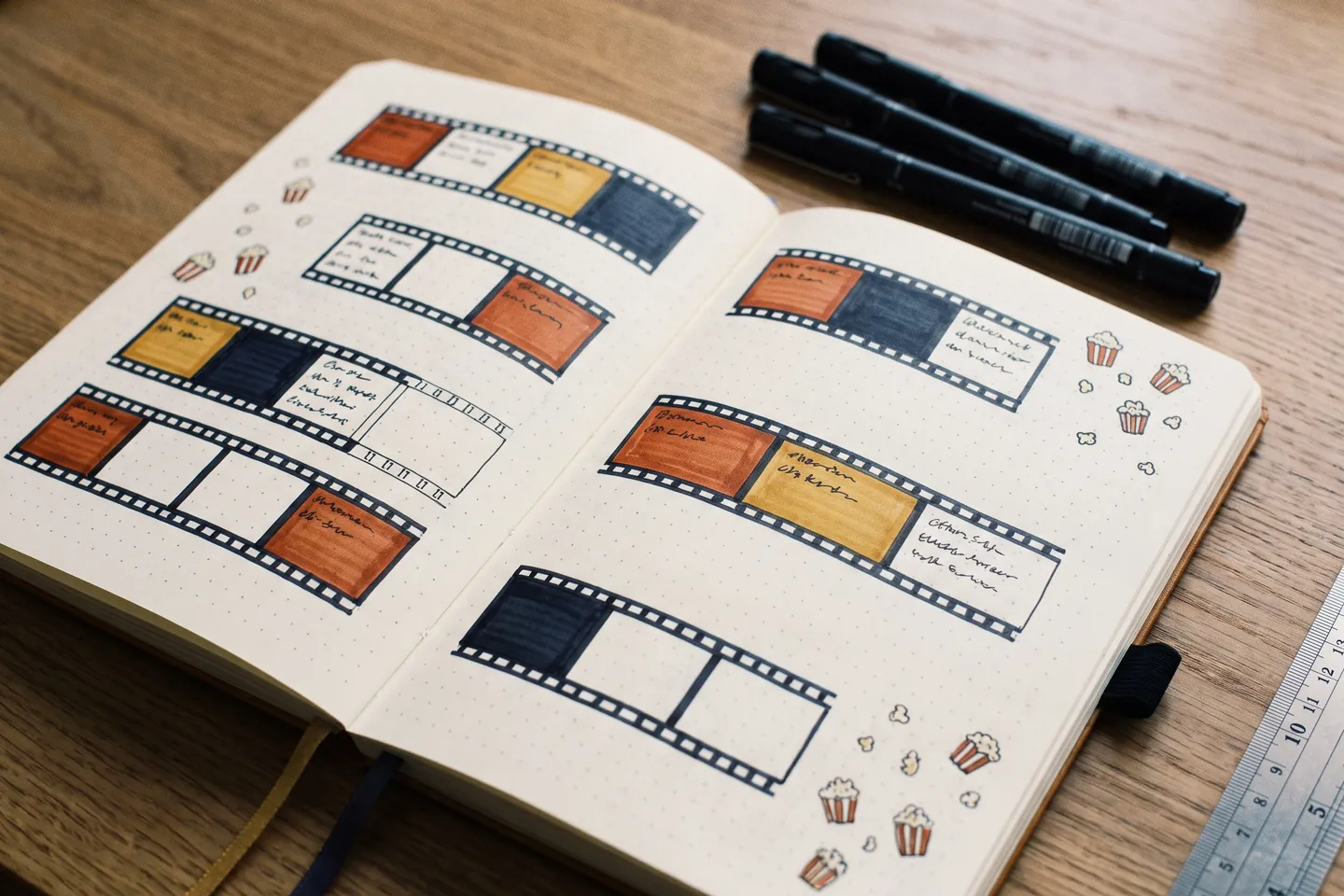
A bullet journal movie tracker works when you choose its layout by how many films you actually watch, not by how pretty the spread looks. Decide first whether you want a watchlist (films to see), a log (films you saw, with a date and a rating) or a challenge (a fixed list to tick off). For a log, give each film one row with five fields: date, title, year, where you watched it, and a star rating. On an A5 dot grid with dots 5 mm apart, that is roughly 37 films per page, so someone who watches two films a week needs about three pages for the year. Add the page numbers to your index so you can find it again. Everything below is the detail behind those choices.
Where a bullet journal movie tracker fits
The Bullet Journal method calls a page like this a collection: information "you kept track of and want to find later," and its own guide says you can create custom collections "to track your interests and hobbies" (How to Bullet Journal, read 2026-10-05). The same guide has you keep the first pages of the notebook as an index, so the one habit that keeps a movie tracker useful is writing its page numbers there the day you draw it. A tracker you cannot find in October is a tracker you start again in October.
Choose the layout by how much you watch
Most inspiration pages show film strips and popcorn buckets. Those look lovely and hold very few titles. The question that decides whether your page survives the year is capacity.
Here is the math for an A5 notebook. A5 is 148 by 210 mm (ISO 216, read 2026-10-05). If your dots are 5 mm apart (check with a ruler), the page is about 41 squares tall and 29 wide. Take three squares for a header and you have about 37 rows. Give each film one row and you fit about 37 films; give each film two rows (one for a short thought) and you fit about 18.
| Layout | Films per A5 page (5 mm grid) | Best for | When it runs out |
|---|---|---|---|
| One-line log: date, title, year, where, stars | about 37 | Anyone watching two or more films a week | A film a day fills a page in about five weeks |
| Two-line log: the same plus one line of thoughts | about 18 | People who want to remember why they liked it | Two films a week fills a page in about two months |
| Film strip or box grid | as many boxes as you draw (a strip of 2 by 8 frames holds 16) | A short watchlist or a themed month | Fast; plan a second strip on the facing page |
| Review page | 1 or 2 | The few films worth a real write-up | Never, because you only use it when you choose to |
| Year at a glance: 12 month boxes, titles only | about 36 to 48 (3 or 4 per month) | Seeing your year in one spread | When a month gets busy; keep titles short |
A good working combination is a one-line log for everything, plus a review page you use only when a film stays with you. That pairing answers the most common complaint about hand-drawn trackers: the decorative spread fills up in the first months and there is nowhere to go next.
What to log for each film
Five fields cover almost everything people look up later:
- Date watched. It turns your log into a diary and settles "did we see that before?"
- Title and year. The year separates remakes from originals.
- Where. Cinema, home, a friend's place, a plane. Two or three letters is enough.
- Rating. Five stars or a 1 to 10 score; pick one scale and keep it all year.
- Rewatch mark. A small "R" next to the title, so your year count stays honest.
Fields people tend to drop by spring: runtime, director and genre for every film. If you want those, put them on the review page instead of the log.
Movie bullet journal page ideas beyond the log
Once the log is running, a few other spreads earn their space:
- Bullet journal movie review page. Title, date, stars, then three prompts: what it was about in one sentence, the scene you will remember, and who you would recommend it to.
- Watchlist. A short list of films to see next, with a box to tick. Keep it to one page and cross out freely.
- Monthly movie spread. A small corner of your monthly log with the titles you watched that month. It takes two minutes and makes the monthly pages fun to flip through.
- Year in film. At the end of December: total count, your top ten, the best film you saw in a cinema, and the one you would never rewatch.
Movie list ideas to fill your tracker
A list with a finish line is easier to keep going than an open "to watch" page. Some that work well as a film bullet journal challenge:
- A published greatest films list. The American Film Institute's 100 Years...100 Movies list (10th anniversary edition) has 100 films with Citizen Kane at number one (AFI, read 2026-10-05). Sight and Sound's critics' poll is held once every ten years and ranks 250 films (BFI, read 2026-10-05).
- One director, start to finish. Every feature, in release order.
- One film per decade. Ten decades, ten boxes, a one-page spread.
- Your birth year. Films released the year you were born.
- A country you have never watched. Five films from one place.
- The long ones. Films you skipped because of the runtime. Set aside a weekend for each.
The longest popular movie, for that last list
If "popular" means films that very large audiences actually saw, Gone with the Wind (1939) is the classic answer. It runs just under 221 minutes of film, about 234 to 238 minutes with overture, intermission and exit music, and was the longest American sound film made up to that point. Adjusted for inflation, it is still the highest-grossing film in history (Wikipedia, read 2026-10-05). Cleopatra (1963) goes longer: it was the highest-grossing film of 1963, premiered at 244 minutes, and its 2013 restoration runs four hours and eight minutes (Wikipedia, read 2026-10-05). On a two-line log, either one deserves a row with "intermission" in the notes.
Other bullet journal themes and topic ideas
A movie tracker sits well next to collections of the same kind: a reading log, a TV show tracker with the episode you are on, a list of places to visit, a gift list, or a yearly habit tracker. Themes for the whole notebook often follow the season, and film fits easily: a horror month in October, a Christmas film list in December, a "films we watched together" page for the family. The rule from the method holds for all of them: if you want to find it later, it goes in the index.
The kinds of movie journals
If you are deciding where your film record should live, there are four kinds:
- A hand-drawn spread in your own bullet journal. Free, fits your notebook exactly, and takes time to draw and redraw when it fills.
- Printable log pages. Ready-made rows you print and keep in a binder, folder or planner. No drawing, and you can print another page when one fills.
- A bound guided movie journal. A finished book with fixed pages. Nice on a shelf, fixed in size and order.
- A tracking app. Counts and searches for you, and lives on a phone rather than in your planner.
Many people combine two: a printed log for the record and a hand-drawn review page in the bullet journal for the films that matter.
If you would rather not redraw the log every few months
Our Movie Journal is a $6.99 printable year of film with 73 pages, and it comes as an A5 file as well as US Letter and A4. The A5 pages are the size of the A5 page used in the math above, so they fit an A5 planner or binder and sit next to your bullet journal at the same size; the Letter and A4 files are there if you keep a full-size binder instead. Inside are the spreads from this guide, already drawn: 12 monthly logs with 31 lines each, a wrap-up page per month, 30 review pages, a year at a glance, 2 watchlists and a year in film page, plus a goals page with a 100-film tracker, trackers for genres, decades, directors, cinema visits, rewatches, firsts and movie nights, a quotes page, a top 25 and your own awards. The PDFs are delivered on the order page right after payment. Nothing is shipped: print at 100% (actual size), at home or at a copy shop. No year is printed, so you can start in any month. If a fixed challenge list suits you better than an open log, the 100 Films Challenge ($1.99) has 100 well-known films from 1939 to 2023 to tick off and rate.
Whichever way you go, draw or print the log first, add it to your index, and keep the review page for the films worth it.
See the printable Movie Journal ($6.99, A5, US Letter and A4)
Frequently asked questions
What are some good movie list ideas?
Pick a list with a clear end: a published "greatest films" list, every film by one director, one film from each decade, the year you were born, or the longest films you have never finished. A list with a finish line is easier to keep going than an open "to watch" page.
What things to put in a bullet journal?
The method's core pages are an index, a future log, a monthly log and a daily log, plus collections for anything you want to find later. A movie tracker is one of those collections, next to reading logs, habit trackers or a gift list.
Can you provide a list of movie journals?
There are four kinds: a hand-drawn spread in your own bullet journal, printable log pages you add to a binder or planner, a bound guided movie journal, and a tracking app. Paper keeps the record next to the rest of your planning; an app does the counting for you.
What's the longest popular movie ever made?
Among films that huge audiences actually saw, Gone with the Wind (1939) is the usual answer: just under 221 minutes of film, about 234 to 238 minutes with overture and intermission, and still the highest-grossing film when adjusted for inflation.
Sources
- How to Bullet Journal (last checked 2026-10-05)
- ISO 216 (paper sizes) (last checked 2026-10-05)
- Gone with the Wind (film) (last checked 2026-10-05)
- Cleopatra (1963 film) (last checked 2026-10-05)
- AFI's 100 Years...100 Movies, 10th Anniversary Edition (last checked 2026-10-05)
- The Greatest Films of All Time (Sight and Sound poll) (last checked 2026-10-05)