 TV & Movie Log Book
Family movie night journal: what to log and how to keep it
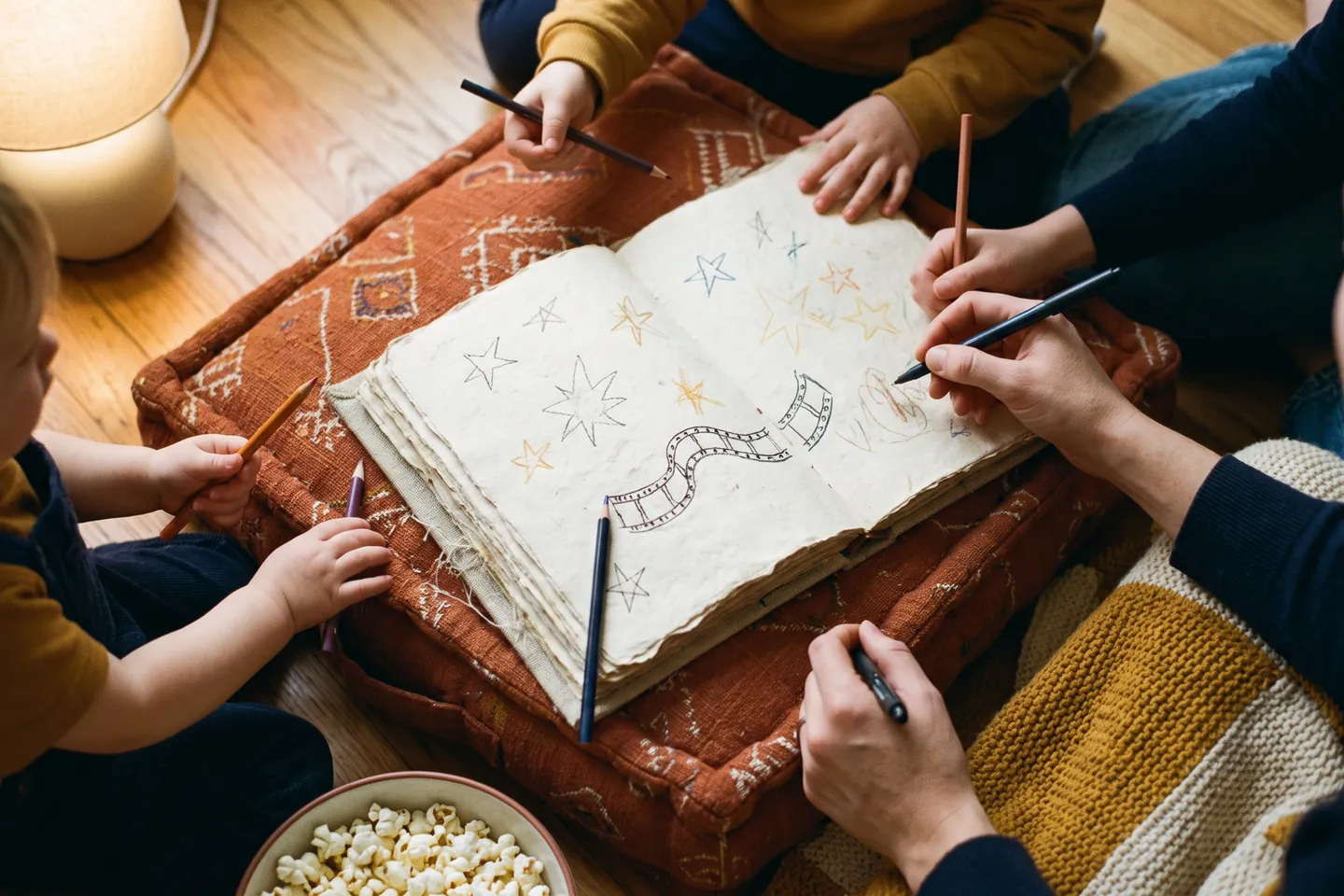
A family movie night journal is one shared notebook where the whole family records each movie night together: the date, who picked the film, the title and year, a star rating from every person, one favorite moment or line, and what you will watch next. Give each night one spread, fill it in on the couch before anyone gets up, let the youngest draw instead of write, and tape in the ticket stub or scorecard if you used one. After a year you have a family record of who loved what, who always picks the scary one, and which film everyone still quotes. The rest of this page covers the fields, how to set it up, how each age can join in, the questions that get kids talking, and a year-end recap.
What goes in a family movie night journal
The trick is to log the night, not just the film. A personal movie log is about what you thought; a family journal is about what happened when you all watched together. These fields do that without turning the evening into homework.
| Field | Who fills it | Example |
|---|---|---|
| Date and night number | The keeper (one adult or an older kid) | Friday, night 14 |
| Who picked | The picker | Mia |
| Film and year | The picker | The Iron Giant (1999) |
| Stars from each person | Everyone, in their own hand | Mia 5, Dad 4, Leo 3 |
| Favorite moment or line | Everyone, one each | "The part on the roof" |
| Snack of the night | The keeper | Popcorn with cinnamon sugar |
| Next pick | Whoever's turn is next | Babe (1995) |
| Stuck in | Anyone | Ticket stub, bingo card, drawing |
Eight fields fit on two facing pages with room left for drawings. If you skip anything, skip the snack line; never skip the individual star ratings, because the disagreements are what make the journal fun to reread.
Set it up in one evening
You need very little to start:
- One notebook that lives with the remote. A sturdy hardcover or a binder both work. If it lives on a shelf in another room, it stops getting filled in by week three.
- One spread per night. Number the nights, not just the dates. "Night 40" means more to a nine-year-old than a date in March.
- A picker list on the inside cover. Write every family member's name in a column and tick the next one each time. Nobody argues about whose turn it is when it is written down.
- A pocket or envelope at the back. Stubs, wrappers and drawings collect there until someone glues them in.
- A rule that it gets filled in before the credits finish. The next morning, half the opinions are gone.
If your family already keeps a bullet journal, give movie night its own collection: one index entry, a picker key at the start, and the same spread layout repeated every week. A bullet journal movie night spread works best when it uses the same boxes every time, so even the youngest knows where their stars go.
A page for every age
The journal only works if everyone can add something. Shape each person's box to what they can actually do.
- Before they can write: a box to draw their favorite scene and five stars to color in. An adult writes down one sentence they say, word for word. These quotes are the best part of the journal a few years later.
- Early writers: stars plus one word: "funny", "scary", "sad", "loud". Let them spell it their way.
- Older kids: stars, a favorite line, and one "I would change" sentence. This is where real opinions start.
- Teens and adults: stars and one sentence each. Keep adult entries short so they do not crowd out the kids.
Let each person write in their own handwriting, even when it is messy. The changing handwriting over the years is part of the record.
Questions that get the family talking
The journal gives the after-film conversation somewhere to land. The American Academy of Pediatrics suggests that watching together is a great way to talk about what kids like and dislike, and advises families to put away phones so everyone is tuned in to the show (read 2026-10-05). Its co-viewing advice also recommends open-ended questions such as "Tell me more about this character" (read 2026-10-05).
Pick one or two questions per night and write the answers in the journal:
- Who would you want as a friend, and why?
- What was the bravest thing anyone did?
- When did you think it would end differently?
- Which part would you skip if we watched it again?
- If you could ask one character one question, what would it be?
Write the question at the top of the spread so you can see later which ones worked for your family.
A sample family movie night journal entry
Here is how one filled spread can look, using a film checked against its Wikipedia entry (read 2026-10-05):
It takes about three minutes. That short length is what keeps a family journal alive after the first month.
Taking turns with the picker rotation
The picker rotation is what turns a pile of movie nights into a journal with characters. Over a year you will see that one person always picks animals, one always picks something with a twist, and one keeps trying to sneak in a film nobody else has heard of.
A few house rules that help:
- The picker can veto one snack, not the film choice of others.
- Two-strike rule: if a pick gets turned off early twice, that person picks from a shortlist of three next time.
- Wild card night: once a month, everybody writes a title on a slip and you draw one.
If you need starting picks for a mixed-age family, a few with checked years: The Iron Giant (1999), Babe (1995) and Hugo (2011) (all read 2026-10-05 on Wikipedia). Check the rating and running time against your own youngest viewer before the night.
Close the year with family awards
The page everyone rereads is the year-end recap. Once a year, usually at New Year or on the journal's first birthday, fill one spread together:
- Best film of the year, by adding up everyone's stars
- Most divided film, the one with the biggest gap between the highest and lowest score
- Best picker, whose choices scored highest on average
- Line of the year, the quote somebody still says at dinner
- Biggest surprise, the film nobody wanted that everyone ended up loving
- Count: how many movie nights you actually had
Doing the math is a good job for an older kid. Then start the next year on a fresh spread, with the picker list carried over so the rotation never resets.
Where printed pages help
You can run all of this in a plain notebook. Printed pages help most with the bits that get filled in on the night and taped in afterwards.
For the night itself, our Movie Night Kit is a $6 printable, 9 pages, with Admit One tickets (8 per page, with film, date, time, seat and a numbered stub), a snack bar menu sign, a "tonight's feature" sign, 2 pages of movie bingo (4 cards), scorecards (4 per page) and a "next pick" vote. The stubs, scorecards and vote slips are made to be filled in by hand, so they glue straight into the journal as each night's keepsake. If you want ideas for running the evening itself, see how to put together a movie night at home kit.
If your youngest viewers want to play along, the Movie Bingo Pack is a $3.99 printable with 40 bingo cards in 5 editions, including a kids edition with picture squares (8 cards per edition, 2 per page, with a call sheet and rules). Picture squares suit the "before they can write" group above, and a played card is one more thing to stick in beside the night's stars.
Both are PDF downloads with US Letter and A4 in one ZIP, delivered on the order page after payment. Nothing is shipped, so print at home or at a copy shop at 100% size. No year is printed, so you can start on any night.
See the printable Movie Night Kit ($6, 9 pages)
Frequently asked questions
What should a family movie night journal include?
One spread per night with the date, who picked, the film and its year, a star rating from each person, one favorite moment or line, and the next pick. Tape the ticket stub or scorecard in beside it.
How do young kids take part if they cannot write yet?
Give them a box to draw their favorite scene and let them color in their own stars. An adult writes one sentence they say out loud, word for word.
How do you keep a family movie journal going all year?
Keep it with the remote, fill it in before anyone leaves the couch, rotate who picks, and close each year with a one-page family awards spread.
Sources
- Watch Together: Co-Viewing Media With Your Child, HealthyChildren.org (American Academy of Pediatrics) (last checked 2026-10-05)
- Why Co-Viewing Is Important: Tips to Share Screen Time With Your Kids, HealthyChildren.org (American Academy of Pediatrics) (last checked 2026-10-05)
- My Neighbor Totoro (1988), Wikipedia (last checked 2026-10-05)
- The Iron Giant (1999), Wikipedia (last checked 2026-10-05)
- Babe (1995), Wikipedia (last checked 2026-10-05)
- Hugo (2011), Wikipedia (last checked 2026-10-05)