 TV & Movie Log Book
Film review template: structure, samples and words to use
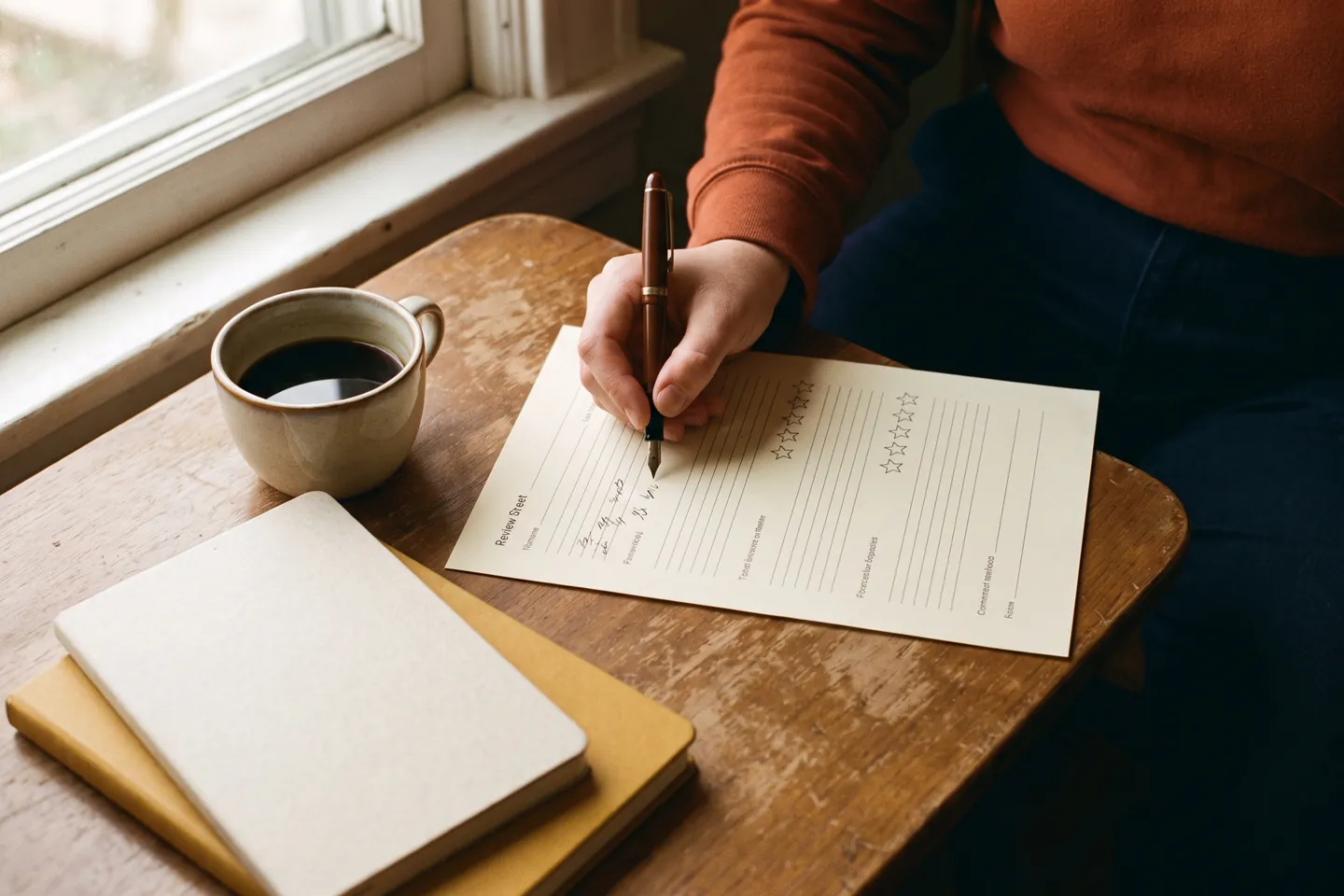
A good film review template has five parts in this order: the film's basic facts and your overall impression, a short summary without spoilers, a description of what the film was like to watch, an analysis of why it worked or did not, and a verdict that says whether you recommend it. The Duke Writing Studio's film review handout (read 2026-10-05) lists exactly these elements and puts a typical review at about 600 to 1,200 words. Below you will find that structure as a template you can copy, a 40-word version for a film journal, two sample reviews and a word bank.
The film review template you can copy
Copy the block below into a notebook, a document or a planner page and fill it in after you watch. Each line is a prompt, not a rule: skip what does not apply to the film.
``` FILM: YEAR: DIRECTOR: WATCHED ON: STARRING: WHERE I WATCHED / WITH WHOM:
-
FIRST IMPRESSION (one or two sentences) My overall feeling, and the one idea this review is about:
-
SUMMARY (three sentences, no spoilers) Who wants what, what stands in the way, where and when:
-
WHAT IT FELT LIKE TO WATCH The look, the sound, the mood. The moment I keep thinking about:
-
WHY (analysis) Story and pacing: Acting: Camera, light, editing, music: What it is about underneath: Did the craft serve the story?
-
VERDICT What worked: What did not: Who should watch it: Rating: ☆ ☆ ☆ ☆ ☆ Would I rewatch? yes / no ```
The order follows two university writing guides. Duke's handout runs introduction, plot summary, description, analysis and conclusion. The APSU Writing Center's movie review handout (read 2026-10-05) gives a nearly identical outline: introduction with title, director and overall impression; a brief summary; analysis; your opinion of what worked and what did not; and a conclusion with a recommendation, with the rating marked optional.
How to structure a film review, part by part
1. First impression. Start with the facts a reader needs (title, year, director, main actors) and your overall feeling. Duke's handout notes that a review does not need a formal thesis but should focus on one central assessment. Decide that idea before you write: "a love story that refuses to be sentimental" gives every later paragraph a job.
2. Summary. Keep it short. Many readers have not seen the film yet, so describe the setup and stop before the turns. Three sentences are usually enough: who the story follows, what they want, what gets in the way.
3. Description. This is the part that is easiest to skip, and the one worth keeping. Say what the film looks, sounds and feels like to you, and name one moment that stayed with you. It is what makes a review yours rather than a plot report.
4. Analysis. Explain the impression. The UNC Writing Center's film analysis guide (read 2026-10-05) lists the elements worth noticing: camera angles, lighting, set design, sound, costume and editing. You do not need to cover all of them. Pick the two or three that actually shaped your reaction and point to a scene for each.
5. Verdict. Remind the reader of your overall view and say who should watch it. A star rating is a summary, not a substitute: one sentence of "because" is worth more than the stars.
How to write a review of a movie in five steps
- Watch once for the experience. Duke's handout suggests surrendering to the film on the first viewing and worrying about your argument later.
- Watch again, or rewatch key scenes, with notes. Write down timestamps of moments that surprised you, bored you or moved you. APSU recommends watching more than once if possible.
- Find your one idea. Look at your notes and ask what connects them. That sentence becomes part 1.
- Fill the template. Write each part fast and roughly first. Specific beats vague: APSU's handout says to support claims with specific examples from the film.
- Cut to length. For a class or a blog, aim for the 600 to 1,200 words Duke describes. For your own journal, see the short version below.
A 40-word version for a film journal
Most people who keep a film log do not want to write 800 words after every movie. A short review still works if it keeps the same skeleton in one line each:
| Part | Prompt | Example (Casablanca, 1942) |
|---|---|---|
| Facts | Title, year, date watched | Casablanca, 1942, watched Friday |
| Impression | One word and one reason | Effortless: no scene wastes a line |
| Moment | The scene you will remember | The singing duel in the café |
| Why | One craft choice that made it work | Dialogue that is quick and dry, never speechy |
| Verdict | Stars and who it is for | 5 stars, for anyone who thinks old films are slow |
That is a full review in about 40 words. Written this way after every film, a year of entries becomes a record you can actually reread.
Two sample reviews: a 5-star and a mixed one
These samples were written for this article to show the template in use. Film facts are checked against Wikipedia's pages for Casablanca and Past Lives (both read 2026-10-05). Neither gives away an ending.
Sample 1, five stars. Casablanca (1942), directed by Michael Curtiz, with Humphrey Bogart and Ingrid Bergman, is the rare classic that feels faster than most new releases. Rick runs a nightclub in wartime Casablanca and wants nothing to do with anyone's cause, until a woman from his past walks in with a husband who needs his help. What stays with me is how much the film says in small exchanges: a glance at the piano, a line thrown away at the bar. The script never stops to explain a feeling; the actors carry it, and the black-and-white lighting does the rest. Every scene pushes toward one choice, and when it comes it feels earned rather than arranged. Five stars, and the best possible answer to anyone who thinks old movies are slow.
Sample 2, three stars. Past Lives (2023), written and directed by Celine Song, with Greta Lee and Teo Yoo, follows two childhood friends from Seoul who reconnect across two decades and two continents. It is quiet, patient and beautifully restrained, and its long pauses let you feel what the characters do not say. That same restraint is where it lost me in the middle stretch: a few conversations circle the same feeling without moving it forward. Greta Lee is luminous throughout, and the final scenes justify the slow build. Three stars for me; more for anyone who loves films that trust silence.
Notice what both do: one central idea in the first sentence, a spoiler-free setup, one concrete moment, a reason for every judgment and a verdict that names who the film is for.
Good words to use in reviews
Strong review words describe an effect you can point to. Weak ones ("good", "bad", "amazing", "boring") only report a mood. Pick one from each row below and attach a scene to it.
| What you are judging | Positive | Mixed | Negative |
|---|---|---|---|
| Story and pacing | gripping, taut, patient, earned | uneven, slow-burning, meandering | predictable, overlong, contrived |
| Acting | luminous, understated, commanding | showy, one-note in places | wooden, mannered, miscast |
| Look and sound | striking, atmospheric, intimate | busy, polished but cold | flat, murky, overscored |
| Overall feeling | moving, witty, haunting | ambitious, divisive | hollow, forgettable, heavy-handed |
APSU's handout also offers useful sentence starters, such as "The film's strongest element is…" and "Overall, [movie title] succeeds/falls short due to…". Use them to get a first draft down, then replace them with your own words.
Where to find examples of good movie reviews
Reading reviews is the fastest way to learn the form. Duke's handout points readers to the arts sections of major newspapers and magazines, naming The New York Times, The Washington Post, The Guardian, The New Yorker, The Atlantic and Rolling Stone. When you read one, run it against the template: find the central idea, the summary, the described moment, the analysis and the verdict. You will see the same five parts in almost every review, in different proportions.
Keeping your reviews on paper
If you want your reviews in one place instead of scattered across notes, our Movie Review Journal is a 45-page printable for $2.99. It has 40 review pages, each in five parts (one line, what worked, what did not, the scene, verdict), with fields for title, year, director, date, where and with whom, stars, best line, rewatch and who you would recommend it to. Two index pages help you find a review again, and a best of the reviews section holds your top ten, your own awards and your favorite lines. It is a PDF download only, nothing is shipped: you get US Letter and A4 files in one ZIP on the order page after payment, and you print at home or at a copy shop at 100% (actual size). No year is printed, so you can start with tonight's film.
See the printable Movie Review Journal with 40 review pages
Frequently asked questions
How do you structure a film review?
Use five parts: basic facts and your overall impression, a short spoiler-free summary, what the film felt like to watch, an analysis of why, and a verdict with a recommendation. Writing guides from Duke and Austin Peay State University describe this same order.
How do you write a review of a movie?
Watch the film once for enjoyment, watch it again for notes, pick one central idea about it, then fill the five parts of the template and back every judgment with a specific moment from the film.
What are 5 star positive reviews examples?
A strong positive review names what works and proves it with one moment, for example: the script does not waste a line, and the final scene earns its reputation because every earlier choice leads to it.
What are some good words to use in reviews?
Choose words that describe an effect you can point to: gripping, restrained, uneven, earned, overlong, luminous, flat. Pair each one with the scene that made you think it.
Sources
- Film Review (Duke Writing Studio handout) (last checked 2026-10-05)
- Movie Review (APSU Writing Center handout) (last checked 2026-10-05)
- Film Analysis (UNC Writing Center) (last checked 2026-10-05)
- Casablanca (film), title and year check (last checked 2026-10-05)
- Past Lives (film), title and year check (last checked 2026-10-05)