 TV & Movie Log Book
Movie journal template: fields, formats and a blank entry
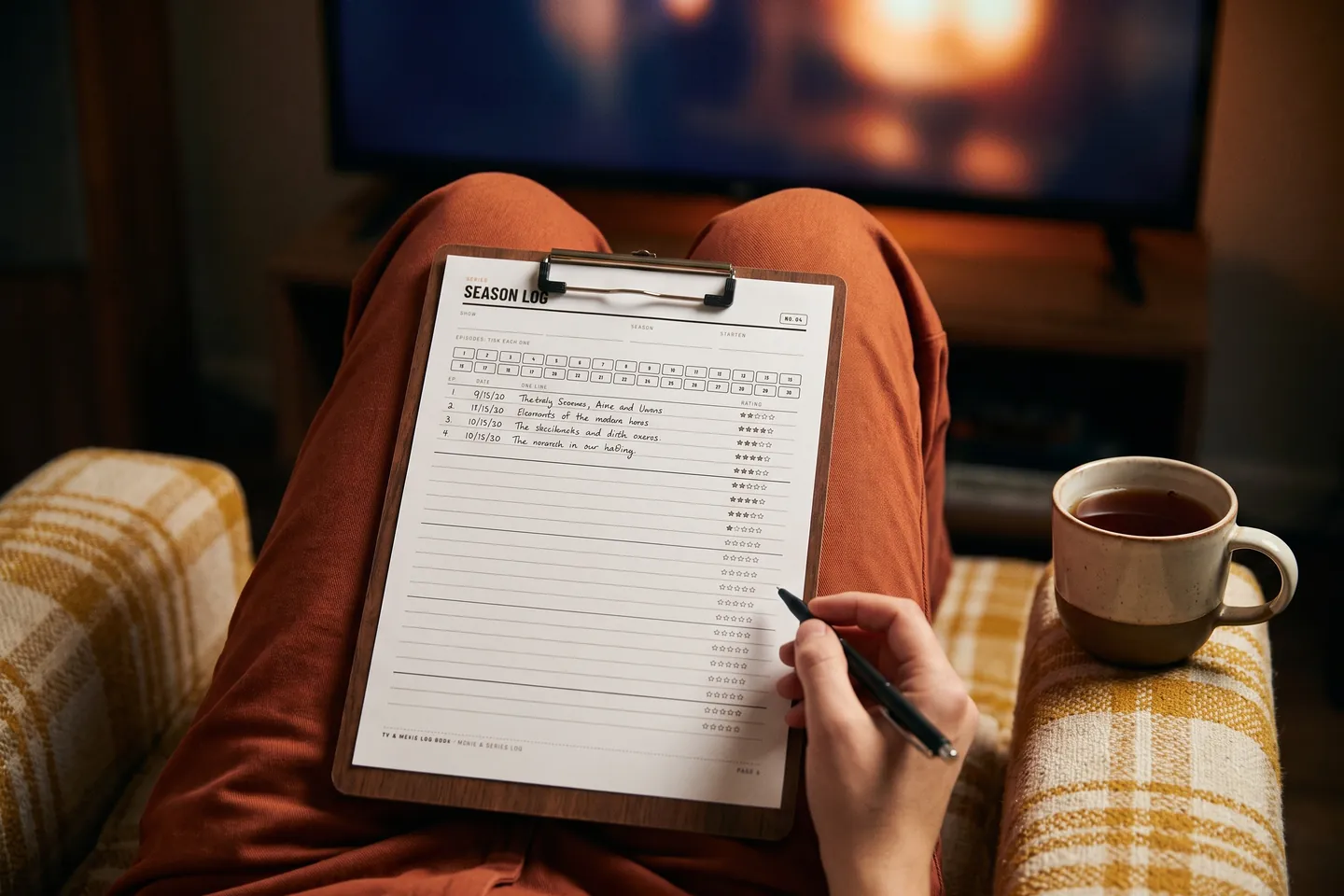
A movie journal template is a page with the same fields for every film, so each entry takes about a minute and your entries line up month after month. The typical format has a log line (date, title, year, where you watched, who you watched with, a rating out of five) and, for the films that deserve more, a short notes block: what stayed with you, one scene, one line to remember, and whether you would watch it again. Use a one-line log if you watch several films a week, a half-page entry if you like to write a few sentences, and a full review page only for the films you want to think about. Below are the fields, the three formats, a blank entry you can copy by hand tonight, and how the same notes turn into a paper if you write about film for a class.
What goes on a movie journal template
Every field should earn its space. If you skip a field three entries in a row, take it off the page. These are the fields that tend to stay useful:
| Field | What you write | Why it helps later |
|---|---|---|
| Date | The day you watched | You can see your year in order, and spot a rewatch |
| Title and year | The film as the credits show it, plus the release year | Two films can share a title; the year tells them apart |
| Where | Cinema, a streaming service, a disc, a friend's couch | You remember the night, not only the film |
| With whom | Names or "alone" | Useful when you plan the next movie night |
| Rating | Stars or a number out of five | A quick sort for your year-end top ten |
| One scene | The moment you would describe to a friend | It brings the whole film back in one line |
| Notes | Two or three sentences on what worked or did not | This is the part you will reread |
| Watch again? | Yes, no, maybe | Turns the journal into a rewatch list |
The first five fields make a log. The last three make a journal. A template can hold both: a short row for every film and more room for the few that matter.
Three formats, and which one fits how you watch
The one-line log
One row per film, many rows per page: date, title and year, where, rating. It suits anyone who watches several films a week and mainly wants to know what they saw and when. It fills fastest and runs out slowest.
The half-page entry
Two films per page, each with the log line plus one scene, a few lines of notes and "watch again?". It suits the person who watches one or two films a week and wants a sentence or two to reread. Most people who say "movie journal" mean this.
The full review page
A whole page for one film: the log line, a longer notes area, favorite line, standout performance, and a closing verdict. It is too much for every film. Keep it for the films you want to think about, recommend, or write about later.
You do not have to choose only one. A common setup is a one-line log for everything plus a review page now and then, so the log stays complete and the long entries stay rare enough to be special.
A blank entry you can copy today
Draw this in any notebook or planner. It is the half-page format, the one that fits most people:
``` Date: __ Title: ____ Year: _ Where: ___ With: ________ Rating: ☆ ☆ ☆ ☆ ☆
One scene I will remember:
What worked, what did not:
A line or a moment to keep: _________ Watch again? yes / no / maybe ```
Fill the top line the night you watch, even if the notes wait until the next day. A log with gaps is harder to trust than a log with short entries.
What is the most important part of a movie to write down?
There is no single agreed answer, and a journal does not need one. What it needs is the part that changed how the film felt to you. Writing guides for film students point at a short list of elements worth noticing: "music, lighting, camera movement, editing, and casting of characters", in the words of the Agnes Scott College writing center (read October 5, 2026). The Swarthmore College film studies writing guide (read October 5, 2026) suggests choosing one, two or three such elements and following how the film uses them.
For a personal journal, that becomes a simple habit: in the notes block, name one element (the score, the light, the cast, the editing) and one scene where you noticed it. That single sentence says more about the film, and about you, than a plot summary.
Taking notes while you watch
You can journal from memory after the credits, and most people do. If you want more detail, study guides suggest a second viewing. The UNC Learning Center (read October 5, 2026) advises watching a film once without notes and a second time for analysis, and adding timestamps "so you can find scenes later on." It also names the tradeoff: writing without pausing means you may miss things, while pausing interrupts the film.
For a journal, a light version works: keep the page next to you, jot a timestamp and three words when something lands, and write the full entry afterwards.
From journal notes to a paper about a movie
A movie journal is good raw material for a class paper, because it already holds dated reactions and scenes. The Writing Center at UNC Chapel Hill (read October 5, 2026) says "the first step to analyzing the film is to watch it with a plan", recommends taking notes with timestamps on the second viewing, and warns against spending too much of the paper on summary at the expense of the argument. The Agnes Scott guide (read October 5, 2026) puts the opening the same way: introduce a concrete, arguable thesis at the beginning, and only talk about the scenes that prove it.
So to start a paper, reread your entry, pick the element you noted (say, the lighting), check the scenes you timestamped, and turn your notes sentence into a claim you can argue. Your journal gives you the evidence. The paper gives it a point.
App or paper template?
The two do different jobs. An app is the better tool if you want search, film details filled in for you, and the same list on every device. A paper movie journal template is the better tool if you want a record you write by hand, keep in a planner or binder, and can flip through without a screen or an account. Plenty of people use both: an app as the catalog, paper as the place where the few films they care about get real notes.
If you choose paper, the questions that matter are practical: does the page fit your binder or planner, and does it print the right size?
Making a printable template work
- Print at 100%, also called actual size. "Fit to page" shrinks the boxes and can crowd the writing lines.
- Match the paper to your binder. US Letter and A4 are close but not the same, and a page in the wrong size tends to stay in a drawer.
- Keep log rows and long entries separate. A page of one-line rows fills slowly; a review page fills in one night. Mixing them makes both hard to find.
- Leave a page for the year's end. A short list of your top ten is the reward for keeping the log all year.
A ready-made journal, if you would rather not draw it
If you would rather print than rule lines, our Movie Journal is a $6.99 printable year of film with 73 pages, and it follows the split above: a one-line log for every film and more room for the few that matter. The log is 12 monthly pages with 31 lines each, plus a wrap-up page per month. The longer entries go on 30 review pages. For the year's end there is a year in film page, a top 25 and your own awards, and along the way a goals page with a 100-film tracker, 2 watchlists, a year at a glance, a quotes page and trackers for genres, decades, directors, cinema visits, rewatches, firsts and movie nights. It comes in US Letter, A4 and A5, so you can print the size that fits your binder or planner. The PDFs are delivered on the order page after payment. Nothing is shipped: you print at home or at a copy shop at 100% and fill it in by hand, starting any time, since no year is printed.
See the printable Movie Journal ($6.99, US Letter, A4 and A5)
Frequently asked questions
What is the typical format for a film journal?
Most film journals use a log line for every film (date, title, year, where you watched, who with, rating) and a short notes block for the films worth more: what stayed with you, one scene, one line to remember, and whether you would watch it again.
What is the most important part of a movie?
There is no single agreed answer. For a journal, the most useful part to record is the element that changed how the film felt to you, such as the music, lighting, camera movement, editing or casting, plus one scene that shows it.
What is the best app for cataloging movies?
An app is the better tool if you want search, automatic film details and a list on every device. A paper template is the better tool if you want a record you write by hand and keep in a planner or binder. Many people use both.
How to start a paper about a movie?
Start with a plan before you watch, take notes with timestamps on a second viewing, then open the paper with a clear, arguable claim and only use the scenes that support it, not a plot summary.
Sources
- Watching Film Analytically, UNC Learning Center (last checked 2026-10-05)
- Film Analysis, The Writing Center at UNC Chapel Hill (last checked 2026-10-05)
- Writing About Film, Agnes Scott College Center for Writing and Speaking (last checked 2026-10-05)
- Film Studies Writing Guide, Swarthmore College Writing Associates Program (last checked 2026-10-05)