 TV & Movie Log Book
Movie ticket journal: keep the stub and what you thought
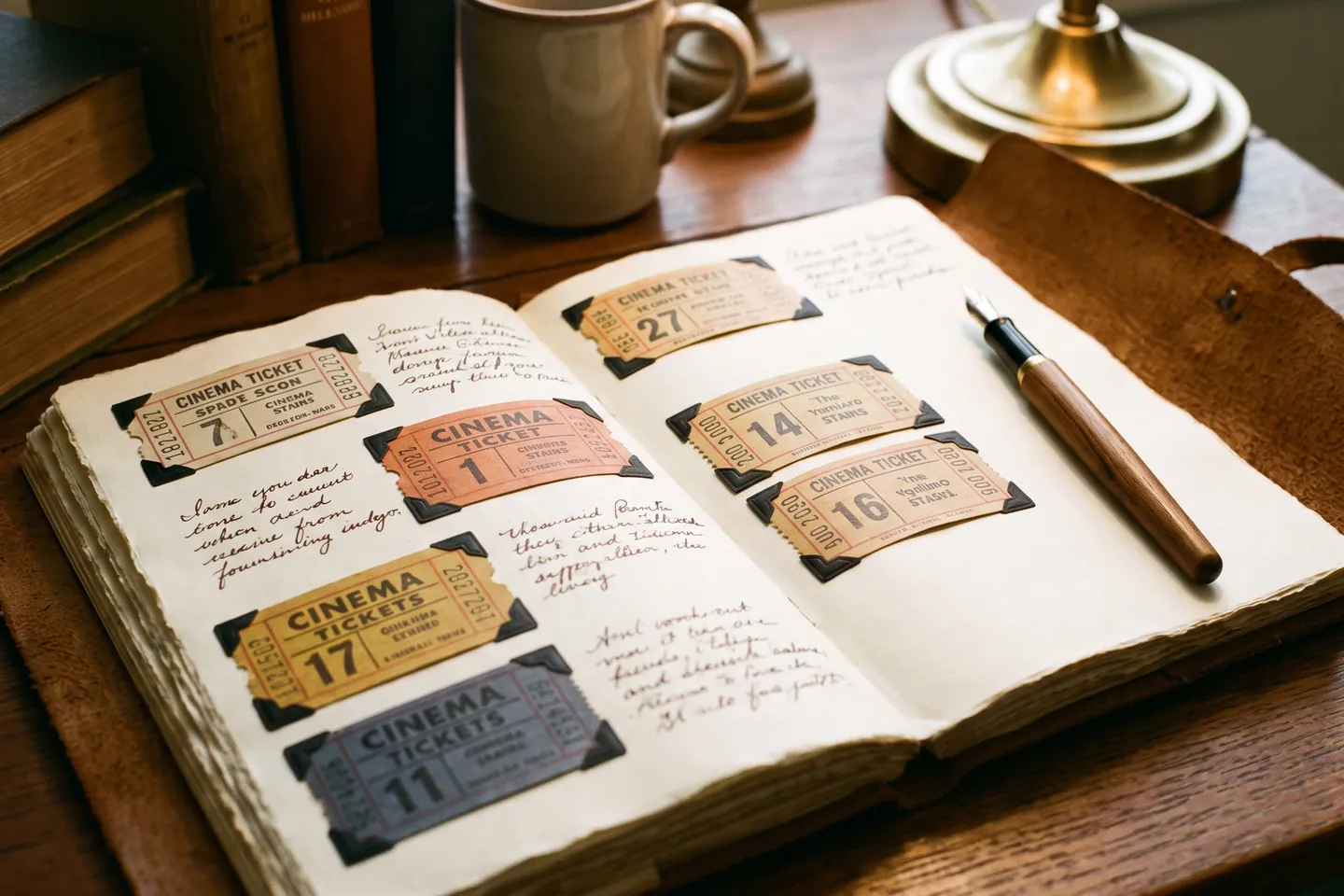
A movie ticket journal is a notebook where every film you see in a theater gets two things side by side: the ticket stub and a few lines in your own hand (date, theater, who you went with, a rating, one sentence about the film). To make it last, do three things on the night you get the ticket: scan or photocopy the stub, because many receipt-style tickets are heat-sensitive paper that fades; attach the original with photo corners, not tape or glue sticks; and write your lines before bed, while you still remember the film. Keep the journal closed and away from sunlight and heat. If you had no paper ticket, make a stand-in stub so the page is not empty.
The rest of this page explains each of those steps, so you can read only the part you need.
What goes next to each stub in a movie ticket journal
The stub already carries the film, the date and often the seat. What it does not carry is you. Five short fields are enough:
- Date and theater. The stub may say this, but stubs fade (see below), so write it again.
- Who you went with. Years later this is often the part you care about most.
- Rating. Stars, a number out of ten, or a simple yes, maybe, no.
- One line. The scene you talked about on the way home, or why it disappointed you.
- Something small from the night. The snack, the weather, the person who laughed at the wrong moment.
Keep it to one sentence per field. A ticket journal that asks for a full review after every film is easy to abandon. If a film deserves more, give it an extra page; our guide on how to make a movie journal covers longer entries and a one-line log for every film you watch, at home or out.
Will your ticket stub fade?
It might. Tickets printed at a box office counter or a self-service kiosk often feel like a shop receipt: smooth, slightly glossy, printed without visible ink. That is usually thermal paper, where the text is made by heat on a coated sheet. The Wikipedia article on thermal paper (read 2026-10-05) gives a simple test: a fingernail rubbed quickly across the paper can make enough heat to leave a mark. Try it on a blank corner.
Thermal prints do not keep well. The same article notes that the dyes "are often unstable" and can return to colorless "when stored in hot or humid conditions," and that the image can fade from UV light, oils and plasticizers. A conservation study in The Abbey Newsletter (December 1989) (read 2026-10-05), written about thermal fax paper, cites one manufacturer's figure of about five years even in good, dark storage, warns that heat can blacken the whole sheet, and advises against PVC folders and solvent-based adhesives or tapes, which "will darken the image."
What that means for your journal:
- Copy the stub the same night. The 1989 study's advice was to photocopy thermal prints onto good paper. A phone scan works too. Keep the copy, or print it small and put it beside the original.
- Copy the words, not just the stub. Write the film, date and theater on the page in pen, so the record survives even if the stub goes blank.
- Keep it dark and cool. No windowsill, no car glove box, no shelf above a radiator.
Not every stub is thermal paper: card tickets from a festival or a special screening may be ordinary printed card. The fingernail test tells you which kind you have, and only the thermal ones need the copy-the-same-night routine.
How to attach stubs without damaging them
The Library of Congress guide to preserving scrapbooks (read 2026-10-05) names ticket stubs among typical scrapbook contents and warns about poor-quality paper, unstable plastics, and tapes or adhesives that discolor or turn sticky over time. Its preservation measures for scrapbooks and albums (read 2026-10-05) recommend:
- acid-free and lignin-free paper,
- polyethylene, polypropylene or polyester plastics (not PVC),
- wheat-starch paste or no adhesive at all, with paper or polyethylene photo corners,
- no rubber bands, self-adhesive tape, paper clips or staples.
For a ticket journal, photo corners are the easiest choice: four corners per stub, the stub slides out when you want to look at the back, and nothing touches the printed face. Clear polypropylene sleeves or pockets work for a stack of stubs from one festival or one summer. Skip the washi tape across the front, however good it looks; it sits directly on the coating the 1989 study warns about.
When there is no paper ticket
Some tickets live only as a code on your phone, and a film you watch at home comes with no ticket at all. A ticket journal does not have to stop there. Make a stand-in stub:
- Print the phone ticket. Screenshot the confirmation, print it small on plain paper, trim it to ticket size and corner it in.
- Draw one. A rectangle with the film, date, time and seat is enough. Some people use a different color for home viewing so the theater nights stand out.
- Use a blank ticket. Our guide to a free printable movie tickets PDF shows how to make your own page of 8 Admit One tickets with lines for film, date, time and seat; filled in by hand, one makes a tidy stub for a night when the theater gave you nothing to keep.
Three layouts, and which one fits
How you lay out the journal depends on how often you go and how much you want to write.
| Layout | How it works | Fits you if | Watch out for |
|---|---|---|---|
| One stub per page | Stub at the top in photo corners, your five fields below | You go a few times a year and want each night to feel like an event | Uses a notebook fast if you go weekly |
| Two stubs per spread | One film on the left page, one on the right, shorter notes | You go about once or twice a month | Stubs make the book bulge; leave every fourth page empty to keep it flat |
| Log plus stub pocket | A numbered one-line log of every film, stubs kept in a sleeve or envelope with the same number written beside them | You go often, or you also want to log what you watch at home | Number the sleeve or the log row, not the stub itself, so nothing touches the print |
The third layout is the one that survives a busy year. The log is where the record lives; the stubs are the keepsakes that back it up. If a stub fades, the log row still says what you saw, when, with whom and what you thought.
If you want the log pages already printed
Ticket stubs need room around them, and no printable replaces a notebook or sleeve for a whole year of them. What a printable can save you is ruling the log by hand. Our Movie Journal is a $6.99 printable year of film with 73 pages, and it includes a cinema visits tracker with a stub box, where a stub can sit in photo corners next to the list of your theater nights. The rest of the year's films go in 12 monthly logs with 31 lines each, with a wrap-up page per month, 30 review pages for the films that deserve more than a line, and a year in film page, a top 25 and your own awards at the end; there are also watchlists, a quotes page and trackers for genres, decades, directors, rewatches, firsts and movie nights. One stub box does not hold a year of tickets, and the journal has no stub pockets: keep the other stubs in a sleeve or an envelope, numbered to match the log rows, as in the third layout above. It comes in US Letter, A4 and A5, delivered on the order page after payment; nothing is shipped, so you print at home or at a copy shop at 100% (actual size). No year is printed, so you can start whenever the next ticket lands in your pocket.
See the printable Movie Journal ($6.99, US Letter, A4 and A5)
Frequently asked questions
What is a movie ticket journal?
A notebook where each film you see in a theater gets its ticket stub plus a few handwritten lines: the date, the theater, who you went with, a rating and one sentence about the film. The stub proves you were there; the lines keep what you thought.
How do you keep movie ticket stubs from fading?
Many stubs are printed on heat-sensitive paper, which can fade or darken with light, heat and some plastics and tapes. Scan or photocopy the stub the night you get it, attach the original with photo corners instead of tape, and keep the journal closed, cool and dark.
What do you put in a movie ticket journal if you have no paper ticket?
Write a stand-in stub: a small hand-drawn or printed ticket with the film, date, time and seat, glued or cornered where the real stub would go. A screenshot of a phone ticket can be printed and trimmed the same way.
Sources
- Preservation Measures for Scrapbooks and Albums (Library of Congress) (last checked 2026-10-05)
- Preserving Scrapbooks: Introduction (Library of Congress Research Guides) (last checked 2026-10-05)
- A Short Research Project into the Permanence of Thermal Fax Papers, Cheryl Jackson (The Abbey Newsletter, Dec 1989) (last checked 2026-10-05)
- Thermal paper (Wikipedia) (last checked 2026-10-05)