 TV & Movie Log Book
Movie journal ideas: 21 pages, prompts and cover ideas
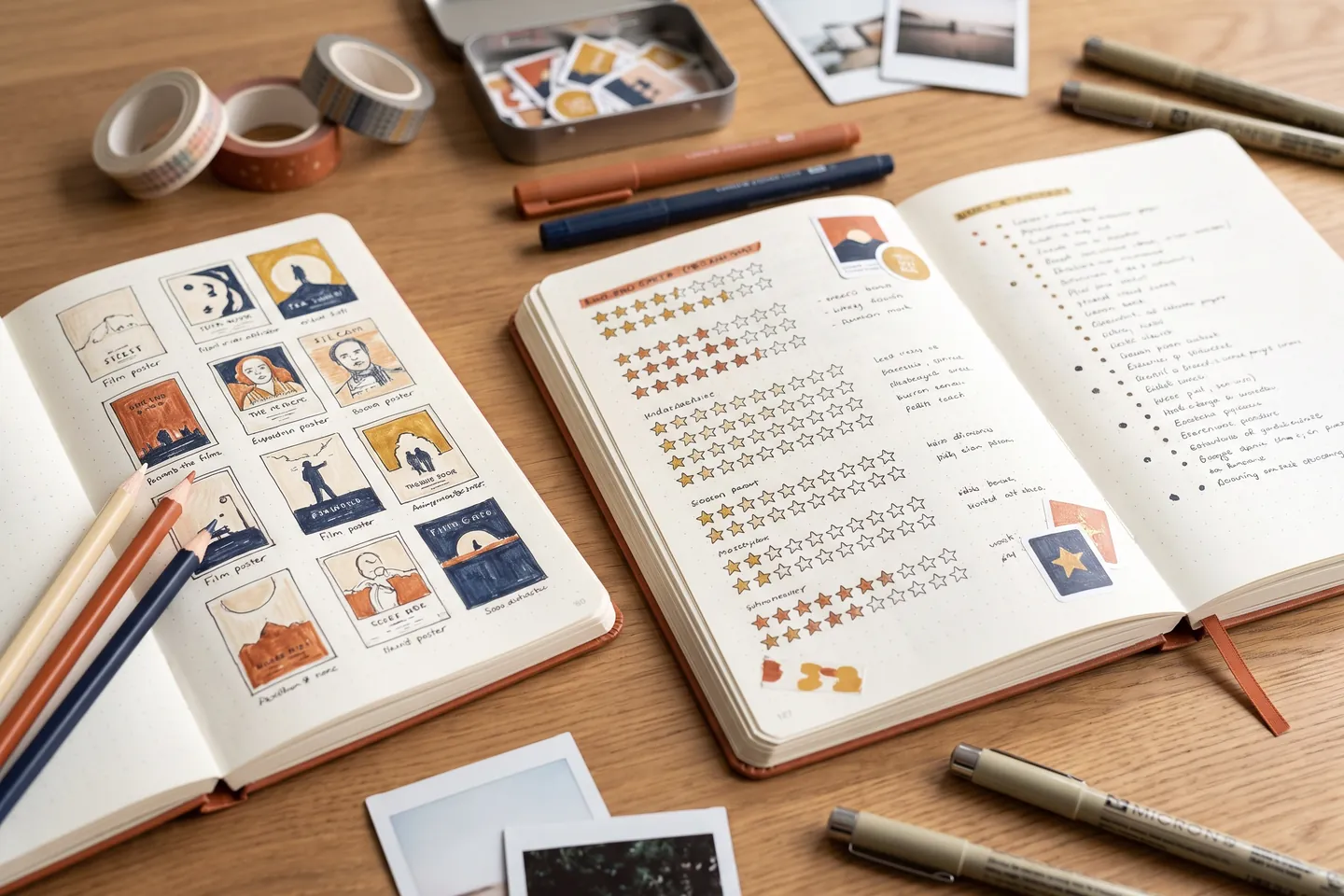
The best movie journal ideas are small pages you will want to repeat after every film, not one big spread you decorate once. Start with a plain one-line log, then add two or three of these: a page of who you watched with, a rewatch ledger, a wall of lines you want to keep, a sketch of one frame, a page for films you gave up on, and a "before and after" prediction. For writing prompts, pick one film craft per entry (camera angles, continuity, cutting, close-ups or composition), write a new tagline, or a letter to a character. On the cover, put the journal's name, your name, the start date and a volume number. Below are all 21 ideas, sorted by how long each takes per film, so you can pick the ones that fit your week.
Movie journal ideas at a glance
| Idea | Time per film | Best for |
|---|---|---|
| Watched-with page, quote wall, abandoned films, recommendation tracker | under 1 minute | Everyone, every film |
| Rewatch ledger, ticket pocket, where it is set, seasonal month | 1 to 3 minutes | People who watch a few films a week |
| Predict and verdict, one C per film, new tagline, double feature | 5 minutes | Anyone who wants to write a little |
| Frame sketch, letter to a character, behind-the-story page | 10 to 20 minutes | The films that stayed with you |
Pick from the top row for every film and from the bottom row only when a film earns it. That split is what keeps a film journal going past February. If you have not set up the basic log yet, the guide on how to make a movie journal covers paper, fields and the first page.
Pages to set up once and fill all year
1. The watched-with page. One line per film: the title and the names of who was in the room, or "alone". A year later, this is often the page worth rereading, because it is really a record of evenings.
2. The rewatch ledger. A film you have seen before gets a row with the date and a new rating. When the same title shows up three times over the years with three different scores, you learn more about yourself than about the film.
3. The quote wall. A page of lines you want to keep, each with the title and year. Write the line the night you hear it; tomorrow you will only remember it half right.
4. Films I gave up on. Title, how far you got, and why you stopped. It keeps the main log honest, and some of these become the best rewatch stories later.
5. The recommendation tracker. Who told you to watch it, and were they right? After a dozen rows you know whose advice to trust.
6. Where it is set. A list of the countries or cities your films take place in, or a simple outline map you color in. It quietly pushes you toward films from places you have never seen on screen.
7. The ticket pocket. Glue an envelope inside the back cover for cinema stubs, and write the stub's date next to the log row. Watching at home? Make your own stub, then file it the same way.
8. A seasonal month. One page for a theme with a finish line: a horror film every night of October, a holiday film each day of December, one director in March. A themed month gives a quiet stretch of the year a reason to open the journal.
Writing prompts for the films that deserve more
If you have wondered what good movie ideas to write about are, these prompts give each entry a single angle, so you never stare at a blank page.
9. Predict, then verdict. Before you press play, write one line: what you expect. After the credits, one line: what it was. The gap between the two lines is often the most interesting thing on the page.
10. One C per film. The "five C's" come from Joseph V. Mascelli's 1965 book The Five C's of Cinematography: camera angles, continuity, cutting, close-ups and composition (Robert C. Morton, read 2026-10-05; the 1965 date is also in Wikipedia's bibliography, read 2026-10-05). They are a cinematography framework, and they make an easy journal prompt: choose one per film and write two sentences about how the film used it. A month of this and you start to notice the cuts and the close-ups on your own.
11. Write a new tagline. Under ten words, the line you would put on the poster. It forces you to decide what the film is actually about.
12. The double feature. Name a second film that would pair well with this one tonight, and say why in one sentence. These pairings turn into a ready-made list for the next movie night.
13. A letter to a character. Three or four sentences to someone in the film: what you would tell them before the third act. It sounds silly and it produces some of the most personal pages in any journal.
14. The frame sketch. Draw one frame from memory in a box the shape of a screen: stick figures are fine. Under it, the scene and why it stuck. You will remember the drawing long after you forget the plot.
Movie trivia pages: the story behind the film
15. The behind-the-story page. Some of the best entries are about how a film was made. Keep a page for production stories you look up after watching, with the source next to each. A few to start with:
- Koyaanisqatsi (1982). Godfrey Reggio's film took about seven years to shoot: production began in 1975 in St. Louis and footage was still being captured in the years after (Wikipedia, read 2026-10-05). It is one answer to "what movie took 7 years to make?", though plenty of films have taken that long for different reasons.
- Boyhood (2014). Richard Linklater filmed it from 2002 to 2014, so the actors age on screen (Wikipedia, read 2026-10-05).
- The Silver Chalice (1954). This is the film Paul Newman apologized for. When it aired on television in 1966, he took out an ad in a Hollywood trade paper apologizing for his performance and asking people not to watch; the broadcast got unusually high ratings instead (Wikipedia, read 2026-10-05).
Write the story in your own words and add whether knowing it changed how you see the film. That last line is what makes it a journal entry and not a fact sheet.
Movie journal cover ideas
16. What to write on the cover. The journal's name ("Films, 2026 onward" or simply "Watched"), your name, the date you started, and a volume number if you plan to fill more than one. Leave a blank line for the end date: writing it in when the last page is full is a small, satisfying ritual.
17. A cover quote. One line from a film that matters to you, small, at the bottom. Choose it last, after the first ten entries, when you know what the journal is turning into.
18. A spine label. If you keep pages in a binder, label the spine with the volume number and years. A shelf of numbered volumes looks like an archive because it is one.
Film journal supplies
19. A short supply kit. One pen you like, one fine marker for headers, a glue stick for stubs, washi or plain tape, and a ruler for log columns. More than that tends to slow down the habit rather than help it.
20. A star stamp or stencil. If you rate with stars, a stamp or a cut stencil makes every rating line look the same, which matters more than you would think when you compare films a year apart.
21. A watchlist bookmark. A strip of card in the journal with the next five films to watch. When one is done, cross it out and move it into the log. If you plan your journal in a dotted notebook, the bullet journal movie tracker guide does the page math for how many films fit per page.
How to choose your first three ideas
Do not start all 21. Pick one page from "set up once" (the watched-with page is the easiest win), one prompt you will use for every film you liked (predict and verdict takes a minute), and one cover idea for the first evening. Add a fourth idea only after a month in which you used the first three without thinking. A movie journal grows best in layers.
If you would rather print the core pages
If you want the core pages ready instead of ruled by hand, our Movie Journal is a $6.99 printable year of film with 73 pages. The base is 12 monthly logs with 31 lines each, a wrap-up page per month and 30 review pages. Several ideas from this list already have a page: a rewatches tracker for the rewatch ledger (2), a cinema visits tracker with a stub box for the ticket pocket (7), a quotes page for the quote wall (3), and 2 watchlists. It also has a goals page with a 100-film tracker, a year at a glance, trackers for genres, decades, directors, firsts and movie nights, a top 25, your own awards and a year in film page. It comes in US Letter, A4 and A5, delivered on the order page after payment. Nothing is shipped: print at home or at a copy shop at 100% (actual size), and no year is printed, so you can start any month. The rest, such as the watched-with page, the frame sketch and the cover, are yours to add on blank pages next to it.
See the printable Movie Journal ($6.99, US Letter, A4 and A5)
Frequently asked questions
What are some cool ideas for a journal?
Give each page one job you will enjoy repeating: a rewatch ledger, a page of people you watched with, a wall of lines you want to keep, a sketch of one frame per film, or a page for films you gave up on. Small, repeatable pages keep a journal going longer than one big decorated spread.
What are the 5 C's of filmmaking?
They come from Joseph V. Mascelli's 1965 book The Five C's of Cinematography: camera angles, continuity, cutting, close-ups and composition. In a movie journal, pick one of the five per film and write two sentences about how the film used it.
What movie did Paul Newman apologize for?
The Silver Chalice (1954), his first film. When it was broadcast on television in 1966, he took out an ad in a Hollywood trade paper apologizing for his performance and asking people not to watch it, which backfired: the broadcast drew unusually high ratings.
What to write on a journal cover?
The journal's name, your name, the date you started, a volume number if you plan to keep more than one, and one line that sets the mood, such as a favorite film quote. Leave space to add the end date when the journal is full.
Sources
- The Silver Chalice (film) (Wikipedia) (last checked 2026-10-05)
- Koyaanisqatsi (Wikipedia) (last checked 2026-10-05)
- Boyhood (2014 film) (Wikipedia) (last checked 2026-10-05)
- The 5 C's of Cinematography by Joseph V. Mascelli (Robert C. Morton) (last checked 2026-10-05)
- Point-of-view shot (Wikipedia, bibliography entry for Mascelli 1965) (last checked 2026-10-05)